
How to Check Landed Property Prices in Singapore?
- William Hong
- Apr 9
- 3 min read

One of the first things most buyers and sellers do when entering the landed property market is simple —they try to find out how much properties are worth.
At first glance, it feels straightforward. Just search online, look at a few past transactions, and you should have a rough idea. But in reality, checking landed property prices in Singapore is not as simple as it seems. While the data is readily available, understanding what those numbers actually mean is where most people get it wrong.
In Singapore, property transaction data is transparent and accessible to the public, primarily through the Urban Redevelopment Authority's portal.
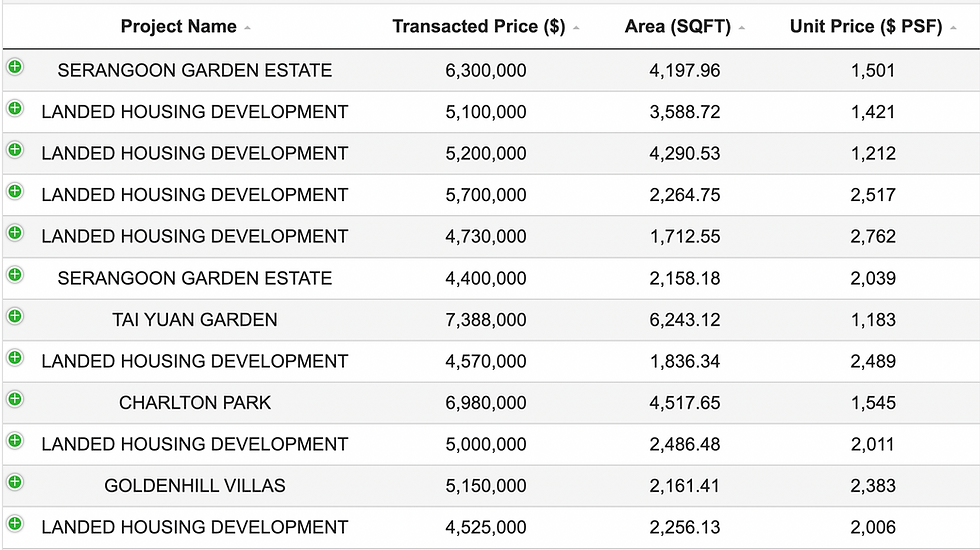
This platform allows users to search past landed transactions, filter by district, and view key information like transacted price, land size, and price per square foot (PSF). For many, this becomes the starting point when trying to determine property value.
However, what many do not realise is that URA transaction data has its limitations. While it provides useful reference points—such as the average PSF, land size, and absolute sale price of each transaction—it does not capture the full picture of what was actually sold. The data does not reflect critical factors such as the condition of the house, level of renovation, or whether the property is a single-storey, two-storey, or three-storey home.
This is important because in landed property, these differences can significantly affect value. A newly rebuilt three-storey home and an original two-storey house on the same land size can transact at very different price levels, even within the same street. Yet on paper, the URA data may make them look comparable.

Because of this, relying purely on transaction data without context can lead to misleading conclusions.
Another common approach is to compare properties based on PSF. While this can be a helpful reference, it needs to be interpreted carefully. In landed homes, PSF can vary widely depending on factors such as plot size, location within the estate, and house condition. Smaller plots, for instance, often show a higher PSF, while larger plots may appear cheaper on a PSF basis but command a higher overall price.
This is why PSF should never be used in isolation.
At the same time, many sellers also look at asking prices on property portals. But this introduces another layer of confusion. Asking prices are simply what sellers hope to achieve—they do not necessarily reflect what buyers are willing to pay. The actual transacted price can sometimes differ quite significantly, depending on negotiation and market response.

What makes landed property even more complex is that no two houses are truly identical. Unlike condominiums, where units are relatively uniform, landed homes differ in terms of layout, frontage, orientation, build quality, and even future rebuilding potential. These factors are often not visible in raw data, but they play a major role in determining value.
As a result, the more important question is not just “What did my neighbour sell for?” but rather:
“How does my property compare to what buyers are choosing today?”
This requires looking beyond past transactions and considering current competition in the market, as well as understanding what today’s buyers actually prioritise.
From what I’ve seen, many homeowners either overestimate their property based on the highest recent transaction or underestimate it based on outdated data. Both approaches can lead to suboptimal outcomes. Overpricing can cause a property to sit on the market and lose momentum, while underpricing may mean leaving value on the table.
The reality is, checking landed property prices is easy. Interpreting them correctly—that’s where experience and strategy come in.
Final Thoughts
For anyone navigating the landed market in Singapore, whether as a buyer or seller, data is just the starting point. What matters more is understanding the story behind the numbers. Because in landed property, the difference between an average result and a strong result often comes down to how well the property is positioned within the current market.
For a more precise understanding of your property’s true value, working with a specialist agent in your area makes a significant difference. Beyond surface-level data, an area-focused agent can provide detailed, on-the-ground insights—such as quantifying the price premium between a two-storey original condition inter-terrace and a renovated one.
Thinking of Selling Your Landed Property?
If you’re trying to understand how much your landed home could realistically achieve—especially in areas like Kovan or Serangoon Gardens—it may be worth looking beyond just the raw data. Sometimes, a clearer perspective on how your property compares in today’s market can make all the difference in the outcome.

![Would I Buy This Freehold Corner Terrace In Kovan for $1,4xx PSF? [Part 2]](https://static.wixstatic.com/media/2ccc8e_83bc5654f50a404a8bd2df01f158dad8~mv2.png/v1/fill/w_980,h_735,al_c,q_90,usm_0.66_1.00_0.01,enc_avif,quality_auto/2ccc8e_83bc5654f50a404a8bd2df01f158dad8~mv2.png)
![Would I Buy This Freehold Corner Terrace In Kovan? Here's My Take [Part 1]](https://static.wixstatic.com/media/2ccc8e_dd2a232c905f4362b2ebf7ac06b92746~mv2.png/v1/fill/w_980,h_735,al_c,q_90,usm_0.66_1.00_0.01,enc_avif,quality_auto/2ccc8e_dd2a232c905f4362b2ebf7ac06b92746~mv2.png)
Comments