
Why Buying Landed Property in Singapore Is Still One of the Best Long-Term Investments


In Singapore’s property market, trends come and go. Interest rates fluctuate, condominium launches dominate headlines, and government cooling measures periodically reshape buyer sentiment. Yet despite all these cycles, one segment of the market continues to hold a unique level of desirability across generations: landed property.
For many Singaporeans, owning a landed home represents more than just an upgrade in lifestyle. It is often viewed as a long-term milestone, a form of wealth preservation, and in many cases, a legacy asset that can be passed down across generations. But beyond the prestige and emotional appeal, an important question remains—does buying landed property in Singapore still make sense as an investment today?
Looking at the long-term fundamentals of the Singapore property market, the answer remains compellingly strong. However, the reasons go much deeper than the common statement that “landed prices always go up.” To truly understand why landed homes continue to hold value and attract demand, it is important to first understand what buyers are actually purchasing when they buy landed property in Singapore.
One of the biggest differences between landed homes and other forms of residential real estate lies in the ownership of land itself. When someone purchases a condominium unit, they own a strata-titled space within a larger development. But when a buyer purchases a landed property, they are acquiring ownership of the land beneath the house. In a country as geographically limited as Singapore, this distinction becomes extremely important.
Singapore is one of the most land-scarce countries in the world, and the supply of landed housing remains tightly controlled. According to market observations and data from Singapore’s residential landscape, landed homes account for only a small percentage of the country’s total housing stock. This scarcity alone creates a strong foundation for long-term value retention. As Singapore continues to urbanise vertically with more high-rise developments, the amount of land allocated for landed housing becomes increasingly finite. Unlike condominiums, where additional supply can still be introduced through new launches, landed housing stock grows very slowly.

This imbalance between limited supply and consistent demand is one of the key reasons why landed property prices have remained resilient over the years.
Recent market movements further reinforce this point. According to reports published by major property portals and analysts in 2026, landed property prices continued to show strength despite a more cautious market environment. Buyers may be more selective today due to global economic uncertainty, but demand for quality landed homes has not disappeared. Instead, it has become more focused. Part of this caution can be attributed to the broader global environment. Ongoing geopolitical tensions and conflicts, such as the Russia-Ukraine War, have contributed to uncertainty across global financial markets. When economic conditions become less predictable, buyers naturally become more prudent with large financial commitments. They take more time to evaluate options, compare opportunities carefully, and avoid rushing into purchases unless they feel fully convinced.
However, prudence should not be mistaken for weak demand.
What we are seeing in today’s landed market is not a disappearance of buyers, but rather a shift in buyer behaviour. Buyers are still willing to commit significant amounts of capital, but only for properties that truly meet their expectations in terms of layout, condition, functionality, and long-term usability.
This trend becomes very clear when looking at District 19. In 2025, buyers could still find 999-year or freehold semi-detached homes with lifts transacting below $6.5 million. But since the beginning of 2026, the lowest recorded transaction for a semi-detached house with a lift has already moved up to approximately $6.78 million. This clearly shows that demand remains strong. Buyers are still prepared to pay premium prices, but only for homes that fully align with modern lifestyle expectations.
[Read More On Buyer Behaviour in 2026: https://www.1roof3storey.com/post/fewer-landed-homes-sold-in-q1-2026-but-demand-is-not-weak-here-s-what-most-buyers-are-missing]
This is one of the biggest shifts in today’s landed market. Years ago, landed property was often associated mainly with prestige or status. Today, buyer motivations have evolved significantly. More families are looking at landed homes from a practical, long-term living perspective rather than purely from a luxury standpoint.
As homeowners move through different stages of life, priorities naturally change. Families upgrading from HDB flats or condominiums eventually begin placing greater emphasis on space, privacy, and flexibility. Larger living areas, dedicated home offices, private outdoor spaces, and layouts that can comfortably accommodate multiple generations become increasingly important.
This explains why modern landed homes with lifts have become highly sought after in recent years. A home lift is no longer viewed purely as a luxury feature. For many buyers, it represents future-proofing. Families are planning not just for their immediate needs, but also for ageing parents, long-term mobility, and the practicality of remaining in the same home for decades.
At the same time, construction costs in Singapore have increased significantly over the years. Rebuilding a landed property today requires substantial financial commitment, longer timelines, and greater coordination with regulatory requirements. Because of this, many buyers prefer paying a premium upfront for a modern, move-in-ready house rather than going through the uncertainty of rebuilding from scratch.
This preference has created strong demand for newer landed homes with efficient layouts, contemporary designs, and features that support long-term family living. Properties that satisfy these criteria continue to command strong prices even in a cautious market environment.
Another factor that makes landed property particularly attractive as a long-term investment is redevelopment potential. Unlike condominiums, landed homeowners have the flexibility to substantially renovate, reconstruct, or rebuild their homes over time, subject to guidelines set by the Urban Redevelopment Authority. This creates opportunities for value enhancement that are rarely available in other residential property types.
An older landed property purchased today does not necessarily remain fixed in its original condition forever. Owners can gradually improve the home according to evolving family needs, modern design trends, or future buyer demand. In many landed enclaves across Singapore, older two-storey houses are regularly rebuilt into modern three-storey homes with attic levels and lifts. Over time, the value of the land itself often appreciates regardless of the age of the original structure. This ability to enhance and reposition the asset contributes significantly to the long-term appeal of landed property ownership.
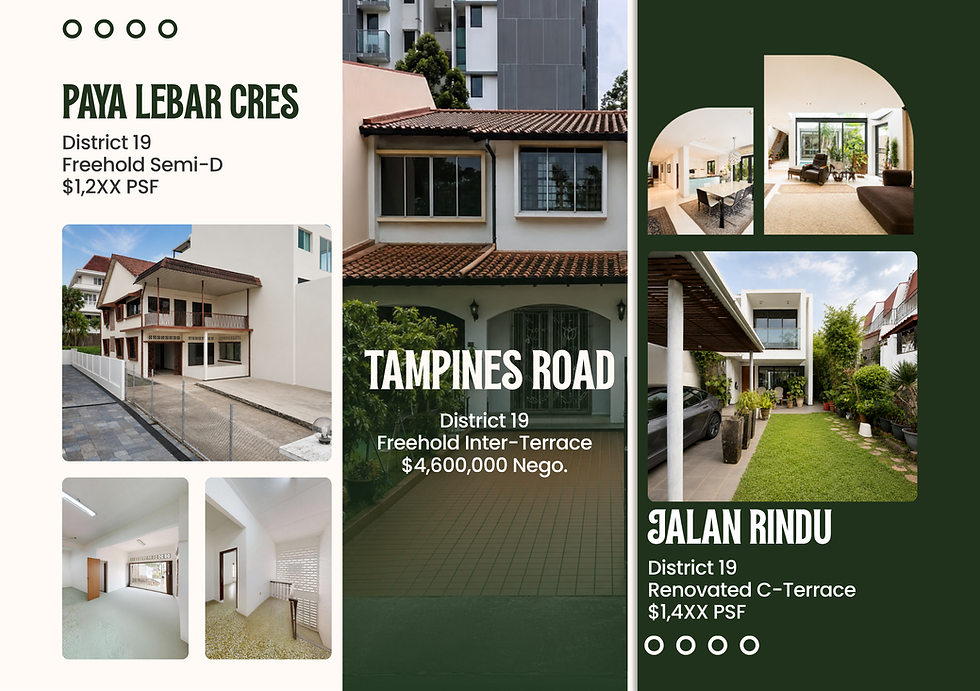
Within District 19, areas such as Kovan and Serangoon Gardens continue to remain highly attractive because they offer a balance that many families are searching for. These neighbourhoods provide established landed enclaves, strong connectivity, lifestyle amenities, reputable schools, and relatively accessible pricing compared to more central landed districts.
At the same time, future infrastructure developments continue to strengthen the long-term potential of these areas. Projects such as the Cross Island Line and future developments around Hougang are expected to further improve connectivity and enhance the surrounding residential environment over time.
This is why many buyers continue to see District 19 as one of the more resilient landed property markets in Singapore.

One common pattern that appears repeatedly in the landed market is buyers waiting on the sidelines in hopes that prices may eventually soften significantly. This hesitation is understandable. Landed homes represent a major financial commitment, and naturally, buyers want reassurance before making a decision.
However, the challenge with landed property is that supply remains fundamentally limited. Over the years, many buyers who delayed their purchase while waiting for prices to drop eventually found themselves chasing a moving market instead. As prices gradually increased, the same type of property became progressively more difficult to enter.

This is especially true within mature landed enclaves where supply turnover is naturally low. Many homeowners hold onto landed properties for long periods, often across generations, which further limits available inventory in the resale market.
Unlike condominiums, where supply can still expand through new launches, landed housing supply remains constrained by Singapore’s limited land availability. And ultimately, this is precisely what supports its long-term value.
Another important point buyers should understand is that landed property tends to behave differently from short-term speculative investments. For most owners, landed homes are not simply about generating quick profits. Instead, they are viewed as long-term wealth preservation assets.
Because land is finite in Singapore, landed properties tend to retain intrinsic value even during uncertain economic periods. This makes them attractive not just from a lifestyle perspective, but also from a generational planning standpoint. Many families see landed homes as assets that can be retained, rebuilt, improved, and passed down over decades. And as Singapore continues to evolve, the scarcity and desirability of landed housing are likely to become even more pronounced.
Ultimately, buying landed property in Singapore is not simply about owning a larger house. It is about owning a finite piece of Singapore itself.
For buyers who understand the long-term fundamentals of the market, landed property continues to represent one of the most resilient and enduring residential asset classes available today.
If you are considering entering the landed market in areas like Kovan or Serangoon Gardens, understanding buyer behaviour, supply dynamics, and long-term positioning becomes increasingly important. Because in today’s market, the difference between an average property decision and a strong one often comes down to recognising where true value really lies.
Whether you’re looking to buy, sell, upgrade, or simply explore the landed property market in District 19, feel free to reach out anytime. I’m always happy to share honest market insights, strategic advice, and help you navigate your landed property journey with clarity and confidence.
DM me or give me a call for a non-obligatory discussion.


Comments